Drivers
Two drivers, one blueprint: How alike are Max Verstappen and Lando Norris?
By Kavi Khandelwal
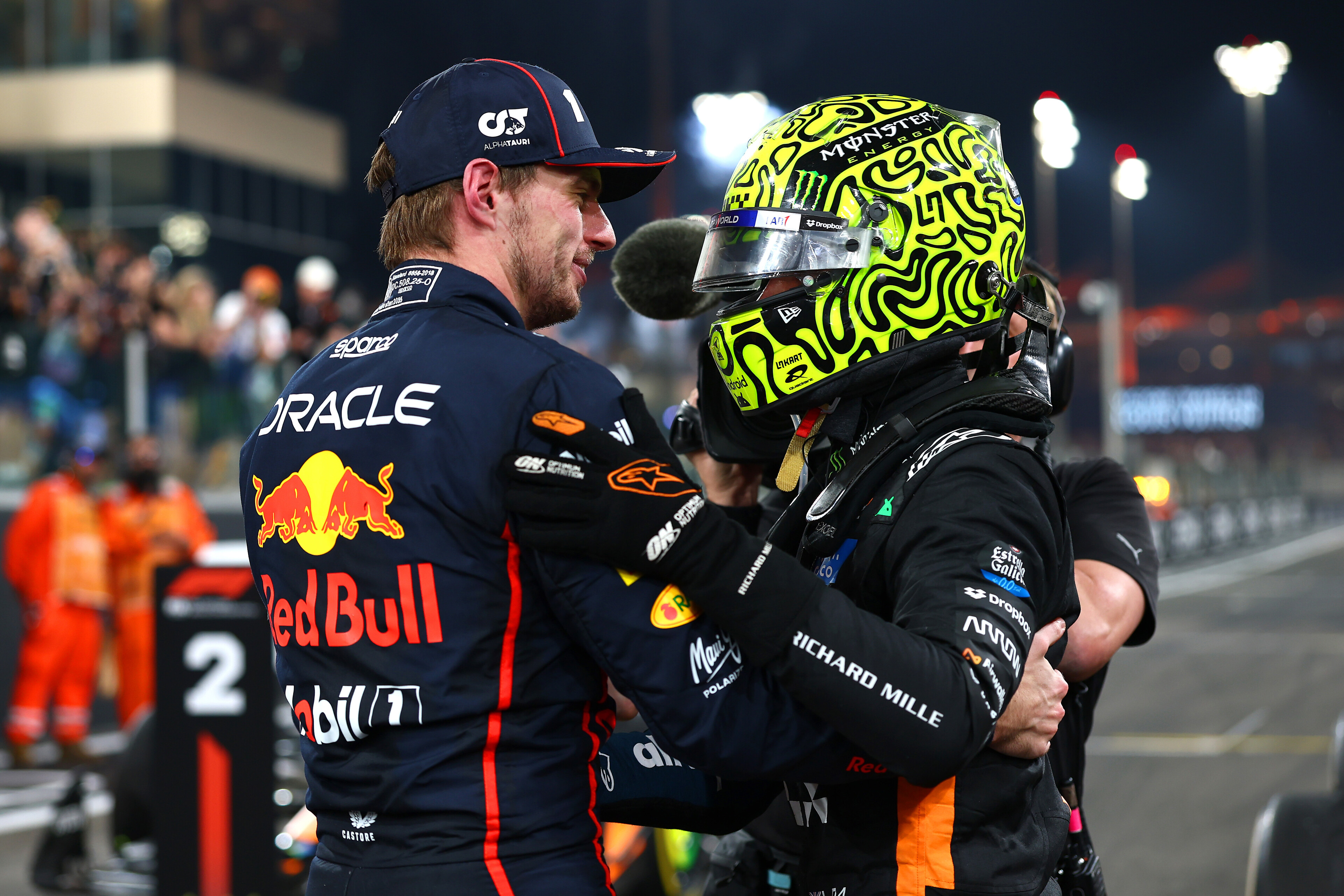
Formula One thrives on the neat dichotomy of the archetype. We crave the cinematic clarity of ice versus fire, the clinical strategist contrasted against the instinctive natural, or the ruthless precision of Max Verstappen juxtaposed with the raw, transparent emotional arc of Lando Norris. It is an immaculate, marketable narrative that the paddock loves to package and sell—but Grand Prix racing is rarely so simple.
It is also only half true. While it is undeniable that the two racers seem to be polar opposites in the way they drive and thrive in F1, it cannot be denied that some of the core qualities of these two World Champions remain the same. It is not something one could notice at first glance, especially with the media narratives surrounding the two. However, those who have been fans for long, and have perhaps a much more open mind than most, will notice that the same things that make up Verstappen also make up Norris. They are, if you will, the same people but in different fonts.
Loyalty as identity, not just contract terms
Both drivers have had every excuse to leave. Neither took it, and the reasons why say more than any quote should. Verstappen was promoted from Toro Rosso to Red Bull’s senior team in 2016, at 18, and has never driven for anyone else since. That decade held together through a period that would have tested any driver’s patience: the early-2024 investigation into then-team principal Christian Horner over allegations of inappropriate behaviour, followed by a very public campaign from Verstappen's own father, Jos, to have Horner removed entirely. When Senior Advisor Helmut Marko came under scrutiny for the fallout, Verstappen made his own position clear before anyone had to ask – if Marko went, he said, he might follow him out the door. Horner survived that round, only for Red Bull to remove him as Team Principal anyway in 2025, replacing him with Lauren Mekies. Through all of it – a team eating itself alive from the inside, a driver’s own father publicly calling for the boss’ head, a management change nobody saw coming – Verstappen never seriously entertained the Mercedes speculation that resurfaced practically every year. He stayed loyal not to any one man in the building, but to the building itself. Norris’ version of loyalty is less about surviving a boardroom war and more about staying through a genuine famine. In 2020, as the pandemic gutted F1’s finances, McLaren became the first team to furlough staff – and Norris and teammate Carlos Sainz volunteered to take the same pay reduction as the mechanics being sent home, rather than sit it out untouched. That wasn’t an isolated low point so much as a symptom: McLaren posted a $137 million operating loss in 2018, four years before Norris even made his F1 debut, and was, by its own later financial disclosures, closer to real trouble than the sport ever fully clocked at the time. Norris was there for the lean years, when McLaren had comparatively little sponsorship to show for itself. He was still there when the turnaround happened – when CEO Zak Brown’s commercial rebuild eventually brought in more than 40 sponsors, so many the team had to install digital screens on the sidepods just to rotate them all, because there was no physical space left on the car for another sticker. He was there for the $614 million in revenue by 2024, the team’s climb to a $4.4 billion valuate, and – the part that actually mattered on a Sunday – the end of a 26-year wait for a constructors’ title in Abu Dhabi that December, followed by his own drivers’ championship in 2025, McLaren’s first since Lewis Hamilton in 2008. The way Norris bleeds McLaren papaya, Verstappen bleeds Red Bull blue.
Fluent in engineering – just not in the same language
It is well known that both drivers understand the technicalities and engineering of an F1 car quite well. However, the “different fonts” truly comes in here. Verstappen’s understanding of a race car wasn’t inherited so much as drilled into him, on purpose, lap after lap. His father Jos – nine seasons in F1 himself, debuting alongside Michael Schumacher at Benetton in 1994 – turned car feel into an actual training exercise once the four-time World Champion was karting competitively. He would quietly change something on the kart’s setup, say nothing about what, and send Verstappen out for a couple of laps to work out exactly what had shifted using feel alone. The rule attached to the drill mattered as much as the drill itself – Jos told him that if he didn’t genuinely feel a difference, he wasn’t allowed to claim one: “if you don’t feel anything, don’t say anything, don’t lie.” That habit of reporting only what’s real, never performing a complaint to sound thorough, is what makes his current shorthand with race engineer Gianpiero Lambiase work. The two have been paired since 2016, and their relationship has reached a level where Verstappen has said Liambiase now simply “knows exactly what I need or want from the car.” His current Red Bull performance coach, Bradley Scanes, has pointed to the same trained reflex still showing up mid-race, years later – Verstappen catching a change to his own car so small it has no real effect on lap time, or clocking a rival’s pit stop purely by the sound of their engine, asking over the radio, “Has the Ferrari just boxed?” It reads like a sixth sense. It’s really a drill, run for over a decade until it became reflex. Norris’ technical grounding came from somewhere far less glamorous: an apprenticeship at McLaren in 2018 that had him, quite literally, brewing tea and pushing a broom around the garage floor before he’d even secured his 2019 race seat. It wasn’t a photo opportunity – it was time actually spent at ground level with the mechanics who’d go on to build his car. He kept that instinct well into his F1 career: after the 2020 Hungarian Grand Prix, exhausted mechanics were mid-way through the post-race pack-down when Norris climbed underneath his own car to help dismantle it, posting a photo with a nod to his team’s three-week grid and the simple line that they “could use a couple more hands.” Just this year, talking with Brown, Norris spelled out exactly why he still does versions of this: he’s taken his engineers go-karting himself, specifically so that when he tells them he’s feeling something in the car, they don’t hear noise – they’ve felt a version of it themselves, rather than, as he put it, wondering “what the hell is this guy saying.” A driver who learned the sport from the ground up, translating that into a language his crew can actually use. Different apprenticeships, same result: two drivers whose technical notes genuinely move the car. Verstappen inherited the shorthand. Norris built his by hand.
Leadership that shows up in debrief
Four drivers’ champions make Verstappen the obvious leader of Red Bull on paper, but the more interesting evidence comes from the man who had to live next to him. Sergio Pérez spent four seasons as Verstappen’s teammate, and in a recent appearance on the High Performance Podcast, he described watching Verstappen operate as leadership education in itself – calling him “a pure leader” who pushes everyone around him toward better performance while identifying exactly where the car, and the team, are falling short. Pérez said the specific trait he carried with him into his next chapter was Verstappen’s habit of giving the team actual direction rather than just feedback – telling them precisely where they were lacking and how to close the gap, something he said he watched play out firsthand alongside figures like Adrian Newey and the senior engineering staff during Red Bull’s most dominant years. Norris leads differently, but the substance holds up. He’s carried more of McLaren’s commercial weight than most drivers would agree to – the sponsorship appearances, the brand-building that helped fuel the team’s financial turnaround, co-founding the esports and apparel brand Quadrant back in 2020, when Mclaren had far less spare capital to spend on image. And the way he treats the people actually building his car has its own quiet consistency. Asked why he keeps staying behind after races to help strip the car down alongside exhausted mechanics, Norris has said it’s partly instinct from karting, partly genuine enjoyment – but mostly about the relationship: “I enjoy spending time and working with the mechanics and the engineers.” After winning his first title in December 2025, he threw a party specifically to thank the people who’d got him there, and personally left a signed race helmet for his childhood karting coach with a handwritten note. A year earlier, at the 2024 Azerbaijan Grand Prix, his race engineer Will Joseph asked over the radio mid-cooldown lap if he could dedicate their fourth-place comeback drive to his late father, who’d died exactly a decade earlier. Norris didn’t hesitate: “Go ahead Will, of course you can.” Small gestures, repeated often enough, are their own form of leadership – the kind that shows up in how a garage feels on a bad Sunday, not just a good one. Both instincts converge in the same place: taking responsibility instead of assigning it. McLaren principal Andrea Stella has said Norris routinely absorbs blame that isn’t fully his, telling the team “it was me, not the team,” even when Stella himself has admitted that isn’t accurate. Verstappen runs the same instinct in reverse, turning his own frustration outward at the collective rather than at any one person: “we need to do better as a team,” he said after a reliability failure cost him a Saudi Arabian Grand Prix win he felt he’d earned. Two very different public temperaments, landing on almost identical language for the same underlying habit – protect the group, fix the process, don’t go looking for someone to blame.
First in line when it matters – and not just for rookies
The clearest evidence isn’t in what either man says about leadership – it’s in who they show up for, and how often, when there’s nothing in it for them. F1’s paddock is smaller than it looks, and word travels fast about who actually checks in when it matters. This version of the two drivers rarely makes it to air – the one that shows up uninvited, for people who never had to ask. Verstappen has become something close to the grid’s default older brother – not by trying to, but because he’s one of the very few drivers left who actually remembers what it was like to be 17 years old inside a paddock this unforgiving. That memory seems to sit behind almost every interaction he has with the newer drivers coming up. When Isack Hadjar took his first Red Bull podium at Monaco in 2026, Verstappen had just retired from his own race in frustration – and still posted on Instagram: “At least I was home early. Congrats on your first podium with the team.” A year earlier, on the cooldown lap of a bad Silverstone weekend, cameras caught him punching the air for Nico Hülkenberg’s first podium in 239 career starts, genuinely delighted for someone else’s milestone in the middle of his own disappointing race. Hadjar, thrown in as his actual 2026 teammate, has described the same quiet consistency up close – Verstappen won’t volunteer advice unprompted, but “if I ask him, he answers.” Norris runs the exact same instinct through a wider circle, and rarely waits to be asked. He was one of the first replies in Kimi Antonelli’s comments section after the Mercedes rookie’s maiden Grand Prix win – “Congrats dude! very deserved” – and when Antonelli was later hit with a wave of online abuse after a late-race mistake handed Norris an advantage in their title fight in 2025, Antonelli confirmed that Norris and Verstappen were both among the drivers who messaged him privately to check in. Verstappen went as far as calling the people responsible “brainless.” When Jack Doohan crashed out of his home-soil Australian Grand Prix on the opening lap, Norris was in the cooldown room reviewing the replay and spoke up for him rather than piling on, saying afterward, “I don’t think people realise how easy it is to do that.” His friendship with Franco Colapinto runs openly enough that after winning the 2025 Monaco Grand prix, Norris used part of his press conference to make a direct appeal to Argentina’s fans on Colapinto’s behalf, laughing that he’s a “great friend of Franco” before asking them to extend some of that support his way too. He’s since been photographed with Oliver Bearman and Gabriel Bortoleto – both now his neighbours in Monaco – grabbing lunch and driving around the principality together often enough that it barely registers as news. None of this is limited to rookies, and that’s the actual point. Drivers across the grid – teammates, rivals, people who’ve since left the sport entirely – tend to speak about both men with a warmth that rarely makes it into the broadcast narrative. Journalists who’ve covered them for years, people behind the scenes on Drive to Survive, even drivers who’ve had every reason to resent losing a seat to one of them, keep landing on the same description: genuinely well-liked, in a paddock that doesn’t hand that out for free. Whatever the media has flattened Verstappen and Norris into – the ice-cold closer, the ever-smiling underdog – it’s a smaller, thinner version of two people who, underneath both reputations, keep choosing to show up for people who never asked them to.
Two of a kind
None of this makes Verstappen and Norris interchangeable – and nobody's arguing that. But the qualities F1 keeps treating as opposites – loyalty, technical fluency, leadership and a genuine instinct to look out for the people around them – are qualities they share almost point for point, right down to the receipts. What differs is delivery: one compressed and instinctive, forged from a childhood spent inside the sport; the other deliberate and built by hand, from a teenager sweeping a garage floor to a champion signing helmets for the people who got him there. Same content. Very different fonts.