Race Report
2026 Miami Grand Prix preview – everything is different this time
By Kavi Khandelwal
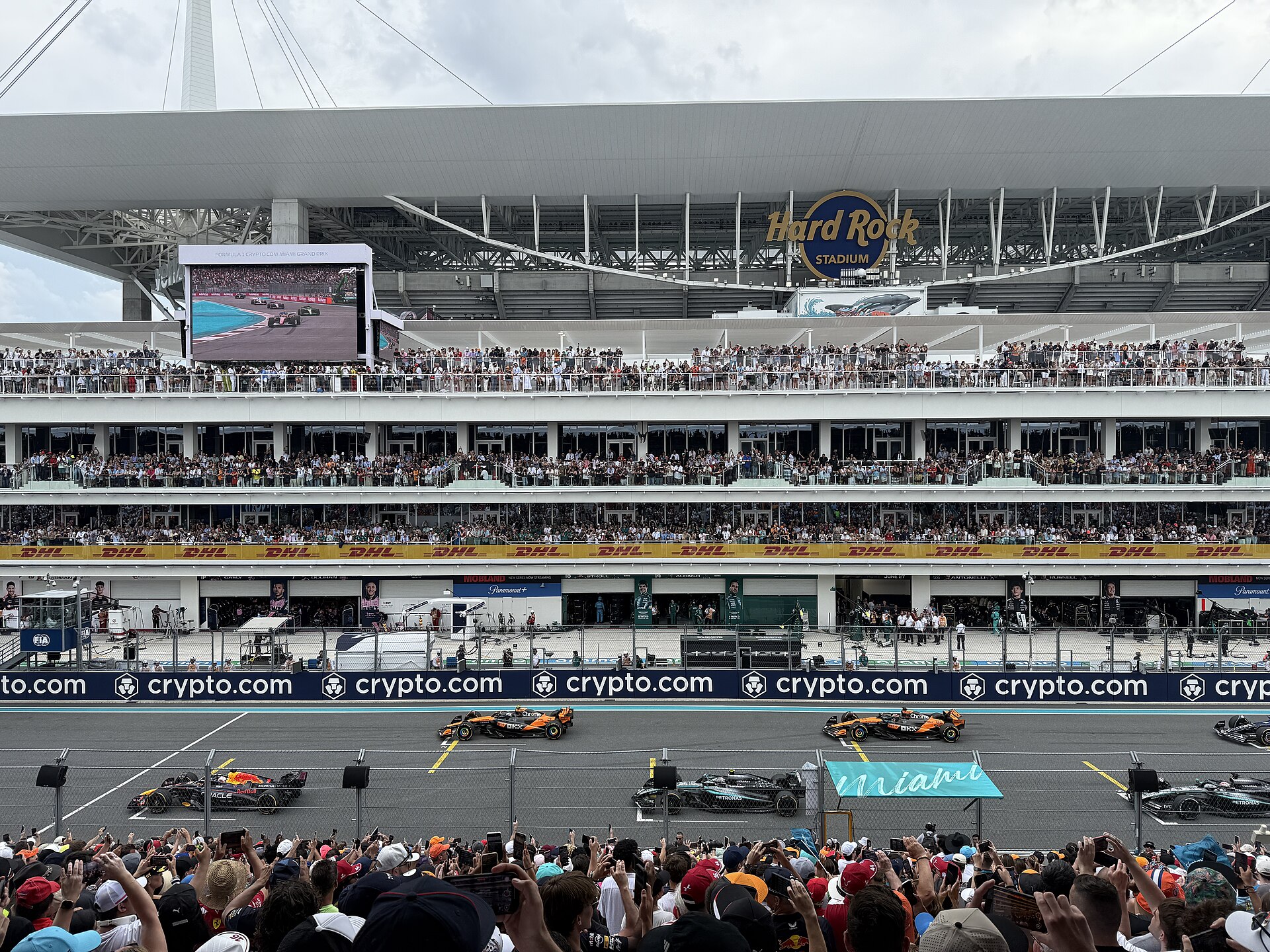
Formula One returns to Miami with new rules, a teenage championship leader, and a five-week break that's reshuffled everything. Florida's about to sort it out.
Formula One returns to Florida this weekend, but the sport it brings with it barely resembles the one that left. Five weeks. That is how long it has been since a F1 car last turned a wheel in anger, following the cancellation of the Bahrain and Saudi Arabian Grands Prix. It is the longest mid-season gap in recent memory, and teams have used every hour of it. Upgrades have been built. Data has been poured over. Regulations have been rewritten. When the lights go out at Hard Rock Stadium on Sunday, May 3, it will feel less like Round 4 of the 2026 season and more like a relaunch of it. Miami has always had a flair for the dramatic. It fits.
The Circuit: Concrete, Carnage, and the Hard Rock
The Miami International Autodrome sits wrapped around the Hard Rock Stadium in Miami Gardens — a 5.412-kilometre loop of 19 corners, three long straights, and enough kerbs to punish the overconfident. It is a temporary circuit engineered to feel permanent, built on public roads and stadium car parks with the kind of polish you only find when a city really wants a race. Elevation changes between Turns 13 and 16 add a subtle but meaningful dimension, as the track rises over an exit ramp and ducks under flyovers across uneven ground. The Turn 14-15 chicane has a crest mid-approach and drops sharply on exit — the sort of detail that catches drivers out when they try to be brave. Setup compromise is everything here. The layout demands quick corners at both the start and end of the lap, connected by two long straights with a slow, technical middle section. High-speed grip or low-speed mechanical traction — you cannot fully have both. And because the surface evolves dramatically across a weekend as rubber builds up on a track that started the event bone-dry and slippery, what works in FP1 rarely looks the same by Sunday afternoon. Pirelli has brought the three softest compounds in the range — C3, C4, and C5. With low degradation historically the norm here, the race sets up as a one-stop, most likely medium-to-hard, with a well-timed VSC capable of turning the whole thing upside down.
The New Rules: Racing rebuilt from scratch
To understand this Miami weekend, you first need to understand what 2026 actually is. This year represents the most significant regulatory overhaul Formula 1 has ever undertaken. The cars are shorter — wheelbase reduced by 200mm — narrower, and lighter, running on a power unit that splits its output roughly 50-50 between a 1.6-litre turbocharged V6 and an electric motor that now produces 350kW, up from 120kW in the previous era. The MGU-H is gone. Advanced sustainable fuel is in. And the cars feature full-time active aerodynamics, adjusting wing angles automatically depending on whether the car is cornering or on a straight. Overtake Mode — an extra boost for the car within a second of the car ahead — has replaced DRS as the primary overtaking tool. It is a breathtaking technical reset. It has also, through the opening three races, revealed some uncomfortable rough edges. Drivers spent the early weeks of the season complaining about involuntary deceleration caused by the cars harvesting energy too aggressively — a phenomenon called superclipping. Closing speeds in unexpected areas became a safety concern. Start-line incidents prompted fresh scrutiny. After weeks of consultation between the FIA, team principals, power unit manufacturers, and the drivers themselves, a package of mid-season rule changes was agreed unanimously. Almost all of them come into force this weekend in Miami. The permitted recharge limit has been cut from 8MJ to 7MJ per lap, targeting a reduction in the superclip duration to roughly two-to-four seconds. At the same time, peak superclip power has been raised to the full 350kW — meaning the harvesting happens faster and gets out of the way sooner, allowing drivers to push more consistently. Race boost limits have been adjusted to reduce the risk of dramatic closing speeds in unexpected areas. A new low-power start detection system has been introduced to protect drivers from a stalled getaway cascading into a first-corner pileup. And the single practice session this weekend has been extended from sixty to ninety minutes to give teams more time to validate both upgrades and the new regulation parameters. Nobody has real-world race data on this package. Miami is the test.
Last year: Piastri takes the spoils in the Florida sun
Cast your mind back to May 2025. Oscar Piastri arrived at Hard Rock Stadium in dominant championship form, leading Lando Norris by ten points with McLaren's orange machine clearly the class of the field. The race itself was straightforward from a strategic standpoint — drivers split between mediums and hards at the start, degradation stayed low, and the pit stop window opened around the midpoint of the 57-lap race. The drama came at the front. Max Verstappen started from pole and initially covered Norris into Turn 1, but locked up at the apex, leaving the door open. Norris drew alongside, and as the pair arrived at Turn 2, a snap of oversteer from Verstappen sent the Red Bull wide. Norris was through. From there, Piastri tracked his teammate down, passed him, and drove to a controlled victory. Verstappen's day unravelled further when a time penalty for an unsafe release — his first points-less finish in any format since the 2016 Belgian Grand Prix — dropped him to 17th. McLaren became the first team to win consecutive Miami Grands Prix, and Piastri cemented himself as a genuine title contender. It was a race that rewarded clean execution over chaos. Whether Miami 2026 will be the same story is another question entirely.
What to watch for this weekend
The championship picture heading into Florida is genuinely unlike anything Formula 1 has served up in years. Kimi Antonelli — nineteen years old — leads the Drivers' Championship, having broken Lewis Hamilton's record as the youngest driver ever to head the standings. He has won in China and Japan. His Mercedes teammate George Russell won the Australian opener and sits nine points behind in second, in the same machinery, under the kind of internal pressure that doesn't need to be spoken aloud to be felt. Russell, with all his experience, cannot afford to let the gap grow. Ferrari arrive with upgrades and a burning desire to end their win drought, which stretches back to Carlos Sainz's victory in Mexico City in October 2024. Charles Leclerc is third in the championship. Lewis Hamilton, in his first season with the Scuderia, is fourth. The pair have been racing each other hard — entertaining battles in both China and Japan — and Miami, with its overtaking opportunities and high VSC probability, could be exactly the kind of race that hands Ferrari their breakthrough moment. McLaren, winners here in each of the last two seasons, come with new parts but unproven pace against a Mercedes that has won all three races of the new era. And then there is Verstappen — ninth in the standings, publicly hinting he might walk away from the sport entirely, and arriving at a circuit with rule changes that could reshape the competitive hierarchy overnight. The new regulations mean nobody truly knows the order. Every team brings upgrades. Every driver carries a new set of parameters to manage. Miami, with its evolving track surface and historically high safety car probability, has a history of producing unexpected outcomes even in familiar seasons. This is not a familiar season. Five weeks off. Everything changed. Now we find out who was ready.